lalp-skills: My Portable Skills Stack for Agentic Coding
A few weeks ago I started rethinking how I build skills for my agentic coding workflow.
I wanted my skills to stop depending on whichever tool I happened to be using. So I built my own stack: lalp-skills, a portable skill stack that works with pi, Claude Code, and Codex.
The goal was simple: reusable skills, composable workflows, and structured context that travels with me instead of living inside one tool.
What's in the stack
It's 28 skills, and every one of them can be called on its own:
- lalp, the orchestrator. It classifies the task and routes it.
- 9 playbooks, one job each: investigate, feature, bugfix, refactor, sweep, perf, prototype, ship, and overnight.
- 8 principles, the rules the playbooks lean on, like root cause, smallest change, and never block.
- 10 disciplines, the procedures the playbooks call: grill, intent spec, tickets, architect, TDD, code review, unslop, and a few more.
It's all pure markdown plus one installer. No executables, no dependencies, no network calls.
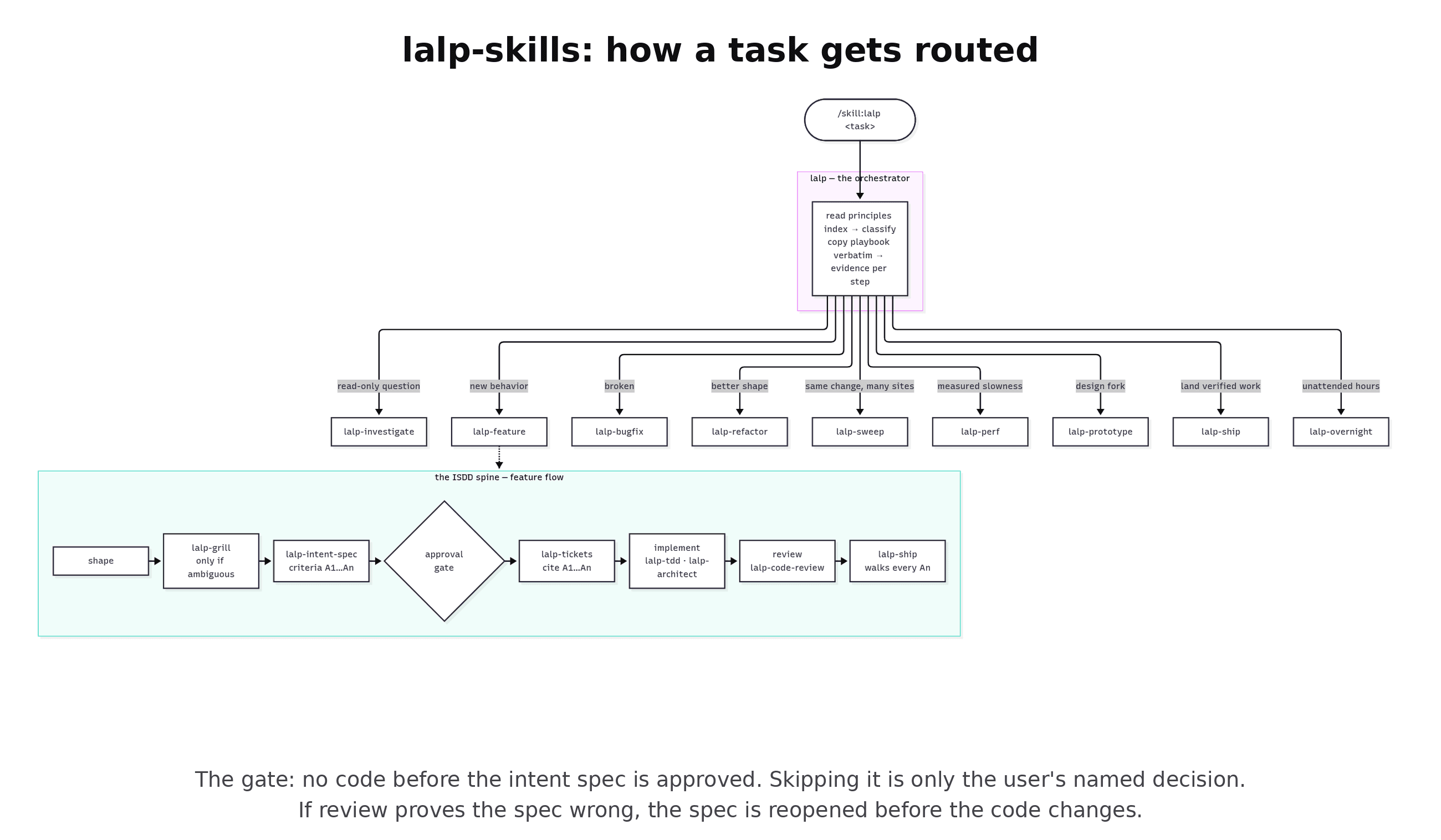
The idea: Intent Specs Driven Development
The whole stack revolves around one artifact: the intent spec.
Before any code, the agent writes down the why and what must be observably true, never the how. That lands in
specs/<name>.md
After that, everything traces back to the spec:
- Tickets cite the acceptance criteria by name.
- Review checks them criterion by criterion.
- Ship walks every criterion with evidence.
- If the implementation proves the spec wrong, the spec gets reopened and re-approved before the code changes.
The spec outlives the PR as the decision record. Every step ends in evidence (the command and its output), not claims.
How I use it
You enter the mode with a prompt shaped like this:
/skill:lalp <what you observed or what you want>Done means <something the agent can run or inspect>.Keep <existing behavior that must not change>.
For example:
/skill:lalp the CLI panics on an empty config fileDone means the repro command exits 0 and a regression test guards it.
Once you're in, the mode is sticky. It stays on across turns until the work lands, or until I say "drop the mode".
When I don't need the full routing, I just call a skill directly:
/skill:lalp-bugfix the login page crashes on empty email/skill:lalp-code-review review this diff before I commit
One repo, every harness
Installing is one command:
./install.sh # symlink all 28 skills into pi, Claude Code, and CodexHARNESSES="pi claude" ./install.sh # only some harnesses
Symlink is the default, so I edit the skill once and every harness updates instantly. The installer never deletes anything it didn't create: name collisions get backed up, not overwritten, and skills that aren't part of the stack are never touched.
A couple of rules keep it portable. Frontmatter is just
name
description
Standing on the shoulders of others
This didn't come out of nowhere. Two big inspirations:
- Matt Pocock's skills, The Main Flow: the idea-to-ship spine, the spec approval gate, and the spec as a decision record.
- pstack by poteto (cursor/plugins): the mode router with playbooks, the principles index, and the architect, teach, and unslop skills I adapted here.
Better systems, not just better models
I'm more and more convinced that agentic development isn't just about better models. It's about building better systems around them 🚀
At least for now 😜